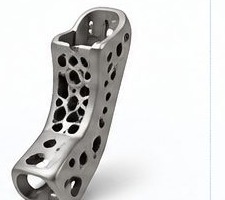
After a severe injury, significant bone loss, or several previous operations, the anatomy can change so much that standard off-the-shelf implants no longer offer the best solution to the reconstructive problem.
In such cases, modern CT imaging, digital 3D planning, and additive manufacturing make it possible to design a custom implant tailored to the anatomy of a specific patient.
When a standard solution may not be enough
Most orthopedic operations are successfully carried out using off-the-shelf implants in standard sizes.
But there are clinical situations in which the surgeon is not dealing with standard anatomy.
This can be caused by:
- a significant post-traumatic bone defect
- loss of part of the bone after an infection
- the consequences of multi-stage surgical treatment
- pronounced post-traumatic deformity
- anatomy altered by previous operations
- a complex defect near a joint
- the need to replace a missing bone fragment
- a situation where a standard construct doesn't match the geometry of the specific defect
In such cases, one possible solution is to design a construct for the specific patient, rather than adapting the patient to an available standard implant.
What is a custom 3D-printed implant
It is an implant whose geometry is designed to match the anatomy and specific reconstructive needs of a single patient.
It is based on computed tomography.
A digital three-dimensional model of the bone is built from the CT scan. It allows a detailed assessment of the defect, its spatial geometry, and how the anatomical structures relate to one another.
From there, the future reconstruction can be planned and the shape and parameters of the needed construct determined.
In other words, we first build a digital model of the planned reconstruction — and only then design the implant to carry it out.
01 — Computed tomography
A CT scan of the relevant segment is performed following the appropriate protocol.
The quality of this initial data is critical, since it becomes the foundation for all subsequent digital modeling.
02 — 3D reconstruction
A digital model of the bone is created from the CT scan.
It allows us to see the defect in three dimensions and assess its geometry in far more detail than a standard X-ray allows.
03 — Digital planning
We determine which anatomy needs to be restored, the position of the future construct, how it will interact with the remaining bone, and the possible fixation options.
In appropriate cases, the anatomy of the healthy opposite limb can be used as a reference for the reconstruction.
04 — Implant design
A digital model of the custom implant is created based on the surgical plan.
At this stage, the surgical and engineering sides of the process effectively merge.
05 — Manufacturing
Once the final design is approved, the construct is manufactured using the appropriate additive manufacturing technology, from a material intended for medical use.
06 — Surgery
The implant is used as part of the reconstruction that was planned in advance.
In this way, the operation doesn't begin in the operating room — much of a complex reconstruction is planned well before the surgery itself.
What individualized planning offers
The main advantage of a personalized construct isn't simply the use of 3D printing.
Its purpose is to help solve a specific anatomical problem.
Depending on the clinical situation, a custom solution can make it possible to:
- recreate the complex geometry of a missing fragment
- adapt the construct to the remaining bone
- plan the required position of the implant in advance
- restore limb length and anatomical relationships
- determine possible fixation points ahead of time
- carry out a reconstruction for which no standard implant is sufficient
3D technology is not the goal of treatment. Its value lies in the ability to carry out the reconstructive plan for a specific patient.
A custom implant isn't always the first stage
With complex post-traumatic defects, the final reconstruction can't always be performed right away.
If infection, nonviable tissue, instability, or other issues are present, a preparatory stage of treatment may be needed first.
The overall strategy may look like this:
removal of nonviable or infected tissue ↓ control of the local situation ↓ temporary stabilization or defect replacement ↓ CT scan and digital planning of the final reconstruction ↓ manufacturing of the custom implant ↓ final reconstruction
So a custom implant should be viewed as part of an overall reconstructive strategy, not as a standalone technology product.
Why the healthy limb is sometimes used
With a complex unilateral defect, part of the normal anatomy may be completely lost.
In such situations, a CT scan of the healthy opposite limb can be used to create its mirrored digital model.
This gives us a reference for what the original anatomy of the injured segment likely looked like before the injury.
The model is then adapted to the specific reconstructive task.
In effect, the healthy side can become the anatomical template for digitally restoring the injured one.
Surgeon + engineer + digital planning
Creating a custom implant is a team process.
An engineer can design a complex construct, but it's the surgeon who determines:
- what needs to be restored
- what the final anatomy should look like
- where the implant can be positioned
- how it will be inserted
- how fixation should be achieved
- how the construct fits into the overall surgical plan
That's why digital design happens through an ongoing exchange between clinical and engineering planning.
The reconstructive problem comes first — the technology second
We don't start with the question "can a 3D implant be printed?"
We first determine exactly what needs to be restored, and whether a custom construct genuinely offers an advantage over standard methods.
We plan the operation in a digital environment
The 3D model allows us to assess complex anatomy and part of the planned reconstruction before we ever reach the operating room.
We combine surgery and engineering
A custom construct isn't created separately from the operation — it's built to match a specific surgical plan.
We consider the whole course of treatment
When a multi-stage reconstruction is needed, each stage has to set up the conditions for the next one.
We don't use 3D printing where a standard solution is enough
A custom solution is justified when it helps solve a problem that would be difficult or impossible to address optimally with standard means.
Custom 3D reconstruction of a significant post-traumatic tibial defect
In complex post-traumatic cases, custom 3D planning makes it possible to move from assessing the defect to creating a personalized construct and carrying out a reconstruction that was planned in advance.
The website presents a real clinical case of reconstructing a significant tibial defect using a custom 3D-printed implant, along with the long-term functional outcome.
Can a 3D implant be made for any defect?
The technical ability to create a custom construct doesn't necessarily mean it will be the best treatment option.
The defect, the condition of the bone and soft tissues, the presence of infection, and possible standard reconstruction options all need to be assessed first.
How does a custom implant differ from a standard one?
A standard implant is mass-produced in a defined range of shapes and sizes.
A custom construct is designed for the specific anatomy and specific reconstructive needs of a single patient.
What material are these implants made from?
The material depends on the type of construct and its purpose. Custom orthopedic implants may be made from biocompatible metal materials, including titanium alloys.
The specific material is determined during the design and manufacturing of the construct.
Why is a CT scan necessary?
A CT scan is the basis for creating an accurate three-dimensional model of the bone.
A standard X-ray remains important for assessing the limb, but personalized 3D design requires spatially accurate digital data about the anatomy.
Why is a CT scan sometimes needed for both limbs?
If the defect is unilateral and part of the normal anatomy is lost, the healthy opposite side can serve as a reference.
Its digital model is mirrored and used to help reconstruct the missing anatomy.
How long does it take to manufacture a custom implant?
This is not a ready-made product taken off a shelf.
A CT scan needs to be performed, a 3D model created, a surgical plan formed, the construct designed, approved, and then manufactured.
The time required depends on the complexity of the case and the manufacturing process, and is determined individually.
Can a custom implant be placed immediately after an injury?
Not always.
With a complex injury, the initial priorities may be stabilization, removal of nonviable tissue, soft-tissue reconstruction, and infection control.
The final custom reconstruction is carried out once the right conditions for it have been established.
Can a 3D implant replace a large missing piece of bone?
In certain clinical situations, custom constructs can be part of the reconstruction of significant bone defects.
Whether this treatment is possible is determined after assessing the specific defect and the entire limb.
Is this better than bone grafting?
Not necessarily.
These are different reconstructive tools with different indications. In some cases, a biological reconstruction is the best option; in others, a custom construct or a combination of methods works better.
What should I do if I've been told there's no standard implant for my case?
The absence of a suitable standard implant doesn't automatically mean a 3D construct is needed.
In a complex situation, it's worth reviewing the CT scan, previous operations, and possible reconstructive options — including getting a second opinion on the best course of treatment.
Is a standard solution not enough for you?
If, after an injury, loss of part of the bone, or several previous operations, you've been told that a standard construct can't solve the problem, it's worth exploring the options for a custom reconstruction.
During the consultation, we'll review your test results and previous treatment and determine whether a custom 3D solution offers an advantage in your specific clinical situation.
A custom implant is not the goal of treatment. The goal is to find the reconstructive approach that best matches your specific anatomy and functional needs.