Pain, swelling, instability, locking, or restricted movement in a joint don't always require major open surgery.
In many cases, injuries to the menisci, ligaments, tendons, and other joint structures can be treated with arthroscopic surgery.
But arthroscopy is not needed for every joint pain. The decision to operate is made after establishing the cause of the symptoms and assessing whether surgery can genuinely improve function.
What is arthroscopy
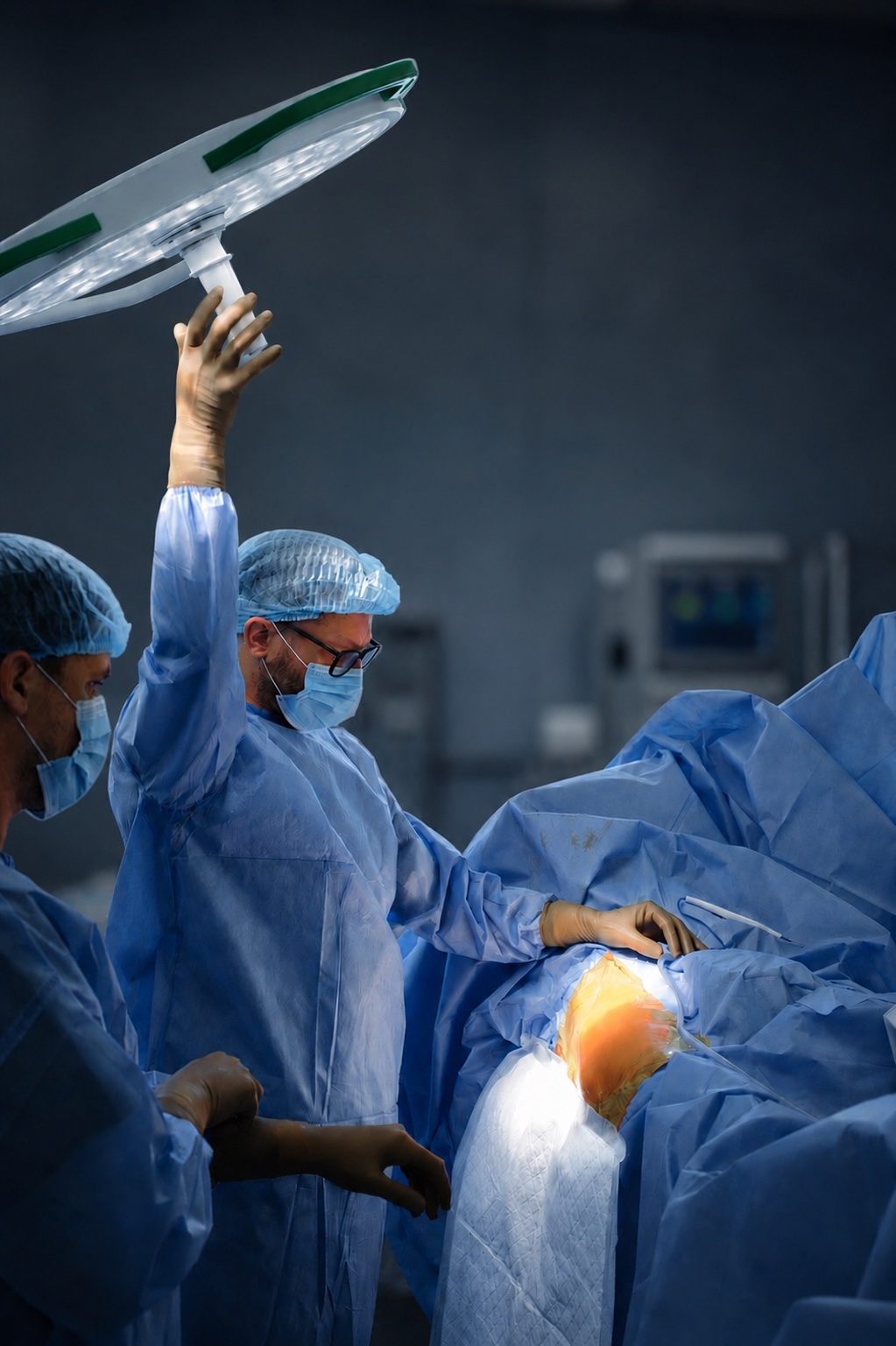
Arthroscopy is a minimally invasive surgical technique in which a special optical instrument — an arthroscope — is inserted into the joint through a small incision.
The image of the joint's internal structures is displayed on a monitor, allowing the surgeon to assess them in detail.
Through additional small incisions, specialized instruments are inserted to perform the necessary surgical procedure.
In this way, arthroscopy not only allows the pathology inside the joint to be visualized, but in appropriate cases also allows damaged structures to be repaired or reconstructed through minimal surgical access.
When to see a doctor
A consultation with an orthopedic surgeon is worthwhile if you are experiencing:
- pain in the knee or shoulder joint
- recurring joint swelling after exertion
- a sensation of locking or the knee "catching"
- instability or a feeling that the knee is "giving way"
- shoulder pain when raising the arm
- shoulder weakness after an injury
- repeated dislocations or instability of the shoulder joint
- restricted range of motion
- the after-effects of a sports injury
- symptoms that persist despite conservative treatment
The first step is to establish the cause of the symptoms.
Only after that can it be determined whether arthroscopic surgery is needed.
Knee arthroscopy
The knee is one of the joints where arthroscopic techniques are especially widely used.
Meniscus tear
The menisci play an important role in load distribution and stability of the knee joint.
A meniscus tear can occur after an injury, presenting with pain, swelling, clicking, or mechanical locking of the knee.
Not every tear requires surgery.
When arthroscopic treatment is indicated, the key question is:
- can the meniscus be preserved?
In appropriate cases, preference is given to repair and meniscal suture. If the nature of the injury does not allow this, only the unstable, damaged portion may be removed.
The goal is to preserve as much functional meniscal tissue as possible, rather than simply removing it.
ACL (anterior cruciate ligament) injury
A tear of the anterior cruciate ligament (ACL) can cause knee instability, especially during running, sudden changes of direction, and sporting activity.
The decision to reconstruct depends on more than just the MRI.
The following are taken into account:
- clinical instability
- age
- level of physical activity
- sporting and occupational demands
- concomitant meniscal and cartilage injuries
- patient expectations
If surgery is indicated, ligament reconstruction is performed to restore stability of the knee joint.
Cartilage and other intra-articular injuries
Arthroscopy can also be used for certain localized injuries to the joint cartilage, loose intra-articular bodies, and other pathological conditions.
The approach is determined by the nature of the defect, the patient's age, and the overall condition of the joint.
Shoulder arthroscopy
Shoulder pain can be related to various structures — the rotator cuff tendons, the labrum, ligaments, and other components of the shoulder complex.
That is why it is important to identify the specific source of the problem before surgery.
Rotator cuff tear
The rotator cuff is a group of tendons that provide stability and movement of the shoulder joint.
Damage to it can cause:
- pain
- night pain
- weakness
- difficulty raising the arm
- reduced shoulder function
Not every tear requires surgery.
But when indicated, the damaged tendon can be repaired arthroscopically and fixed back to the bone.
Shoulder instability
After a traumatic shoulder dislocation, the structures that provide joint stability may be damaged.
In some patients, repeated episodes of instability occur after the first dislocation.
This is especially relevant for young and physically active people.
In appropriate cases, arthroscopic surgery allows the damaged stabilizing structures to be repaired.
It is important to assess not only the soft tissues but also any potential bone loss, since a significant bone defect may require a different reconstructive strategy.
Do you actually need arthroscopy?
This is one of the key questions addressed on this page.
Not every meniscus tear needs surgery.
Not every rotator cuff tear requires immediate surgery.
Not every joint pain can be cured with arthroscopy.
The decision depends on the cause of the symptoms, the nature of the injury, age, activity level, duration of the problem, and the results of prior treatment.
The mere presence of changes on an MRI does not automatically mean surgery is necessary.
We treat the patient and the impairment of their joint function — not the MRI image.
MRI showed a tear — what's next?
MRI reports often contain wording that sounds alarming to a patient: "meniscus tear," "degenerative changes," "cartilage damage," "tendon tear."
But an MRI result needs to be assessed together with:
- your symptoms
- the history of the injury
- clinical examination
- age
- physical activity
- the overall condition of the joint
Sometimes the changes described on an MRI are not the main cause of the pain.
So an MRI helps inform the decision, but it does not make that decision instead of the doctor.
What can change after surgery
The outcome depends on the specific condition and the type of procedure.
The goal of arthroscopic treatment may be:
- reducing pain
- eliminating mechanical locking
- restoring stability
- repairing a damaged meniscus
- reconstructing a ligament
- repairing a tendon
- improving range of motion
- returning to everyday and sporting activity
It is important to understand that arthroscopy cannot "make the joint new" and does not eliminate every cause of pain.
This is especially true for advanced arthritis, where the problem is no longer a single damaged structure but significant, widespread damage to the joint as a whole.
01 — Consultation and examination
We identify the nature of the symptoms, the mechanism of injury, activity level, and functional limitations.
We perform clinical tests to assess specific joint structures.
02 — Imaging
Depending on the condition, X-ray, MRI, and in certain cases CT scans are used.
03 — Choosing a strategy
We determine whether the problem can be treated conservatively, or whether surgery offers a clear, justified advantage.
04 — Arthroscopic surgery
The necessary procedure is performed through small incisions, according to the pathology identified.
05 — Recovery
Rehabilitation depends on the surgery performed.
After a minor procedure, recovery can be relatively quick. After a meniscal repair, ligament reconstruction, or rotator cuff repair, a longer, supervised process is required.
We don't operate on MRIs
The decision to operate is made based on a combination of symptoms, clinical examination, and imaging results.
A change seen on MRI is not, by itself, an indication for arthroscopy.
We preserve what can be preserved
If a meniscus or other structure can reasonably be repaired, a tissue-sparing approach is preferred.
We restore function, not just fix damage
The end goal is a stable, mobile, and functional joint.
We plan rehabilitation together with the surgery
The outcome of ligament reconstruction, meniscal repair, or tendon repair depends heavily on properly structured post-operative recovery.
We don't offer arthroscopy where it won't solve the problem
In cases of advanced arthritis or other significant structural damage to the joint, arthroscopic surgery may not deliver the expected result.
In such situations, it is important to identify a different, more suitable treatment option.
A complex recurrent knee injury after previous surgery
The patient had previously undergone surgical treatment of the knee. During a follow-up MRI, a complete rupture of the anterior cruciate ligament (ACL) graft was found, together with a vertical tear of the lateral meniscus and a meniscocapsular injury of the posterior horn of the medial meniscus (a ramp lesion).
The MRI also showed associated post-traumatic and post-surgical changes.
MRI of both knees. Right — a repeat injury to the anterior cruciate ligament graft along with associated meniscal injuries after previous surgical treatment; left — a comparative scan of the other knee.
What matters in a situation like this?
Even findings this pronounced on MRI do not, by themselves, determine the final treatment strategy. The imaging results must be weighed together with the patient's complaints, the clinical stability of the knee, level of physical activity, the outcome of the previous surgery, and functional needs.
Only after this comprehensive assessment can it be determined whether repeat surgery is needed, which structures require repair, and what scope of surgery would be appropriate.
MRI shows the structure of the injury. The surgeon's task is to determine its clinical significance and choose the right treatment strategy.
Have you been recommended arthroscopic surgery?
If the surgery is elective and the clinical situation allows time for a decision, you can get a second opinion on the proposed treatment.
This can be especially useful if:
- surgery was recommended based on the MRI alone
- it is unclear whether conservative treatment could be tried first
- removal of part of the meniscus has been proposed
- there is uncertainty about whether ligament reconstruction is needed
- rotator cuff surgery has been recommended
- the symptoms and MRI findings do not seem fully clear to you
During the consultation, the MRI results can be weighed against your symptoms and clinical picture to determine whether surgery is really needed and what problem it should solve.
Can arthroscopy be done just for diagnosis?
Modern MRI and other imaging methods provide a great deal of information without surgery.
That's why arthroscopy is usually planned when there is a specific surgical task to accomplish, not simply to "look inside the joint."
If the MRI shows a meniscus tear, does it always need surgery?
No.
The approach depends on the type of tear, symptoms, age, mechanism of injury, and the overall condition of the knee joint.
Is it better to remove or repair the meniscus?
If the nature of the injury, its location, and tissue quality allow for acceptable healing conditions, preserving the meniscus may be the priority.
But not every tear is technically and biologically suitable for repair.
How long does arthroscopic surgery take?
The duration depends on the procedure.
A simple arthroscopic procedure and a complex ACL or rotator cuff reconstruction are fundamentally different operations.
When can I walk after knee arthroscopy?
This depends on exactly what was done.
After some procedures, weight-bearing is allowed early on; after others, it must be temporarily restricted to protect the repaired structure.
When can I drive a car?
The timeline depends on which joint was operated on, the side of the surgery, the nature of the procedure, control of the limb, and use of pain medication.
Returning to driving should be based on safety, not just the number of days since surgery.
When can I return to sport?
This depends on the surgery.
After ligament reconstruction or tendon repair, return to sport is a separate stage of rehabilitation, determined not just by time since surgery but by the recovery of strength, stability, and functional performance.
Will there be scars?
Yes, but arthroscopic incisions are usually small.
The number and location of scars depend on the specific surgery.
Does arthroscopy help with arthritis?
In advanced arthritis, arthroscopic surgery usually cannot address the underlying problem — significant wear of the joint surfaces.
That's why it is important, before surgery, to determine whether there is a specific pathology that arthroscopic treatment can genuinely correct.
Do I need an MRI before the consultation?
Not always.
If an MRI has already been done, it's best to bring not just the report but the images themselves.
If the scan hasn't been done yet, in some cases it is better to have an examination first and then obtain the necessary imaging afterward.
Is your knee or shoulder hurting?
If pain, instability, locking, or restricted movement don't go away, the first step is to identify the structure causing the problem and understand whether it requires surgical treatment.
If an MRI has already been done, or arthroscopy has already been recommended to you, the consultation can be used to review the results, discuss alternatives, and determine a possible strategy.
Arthroscopy is a tool. What matters most is correctly identifying the problem that tool is meant to solve.