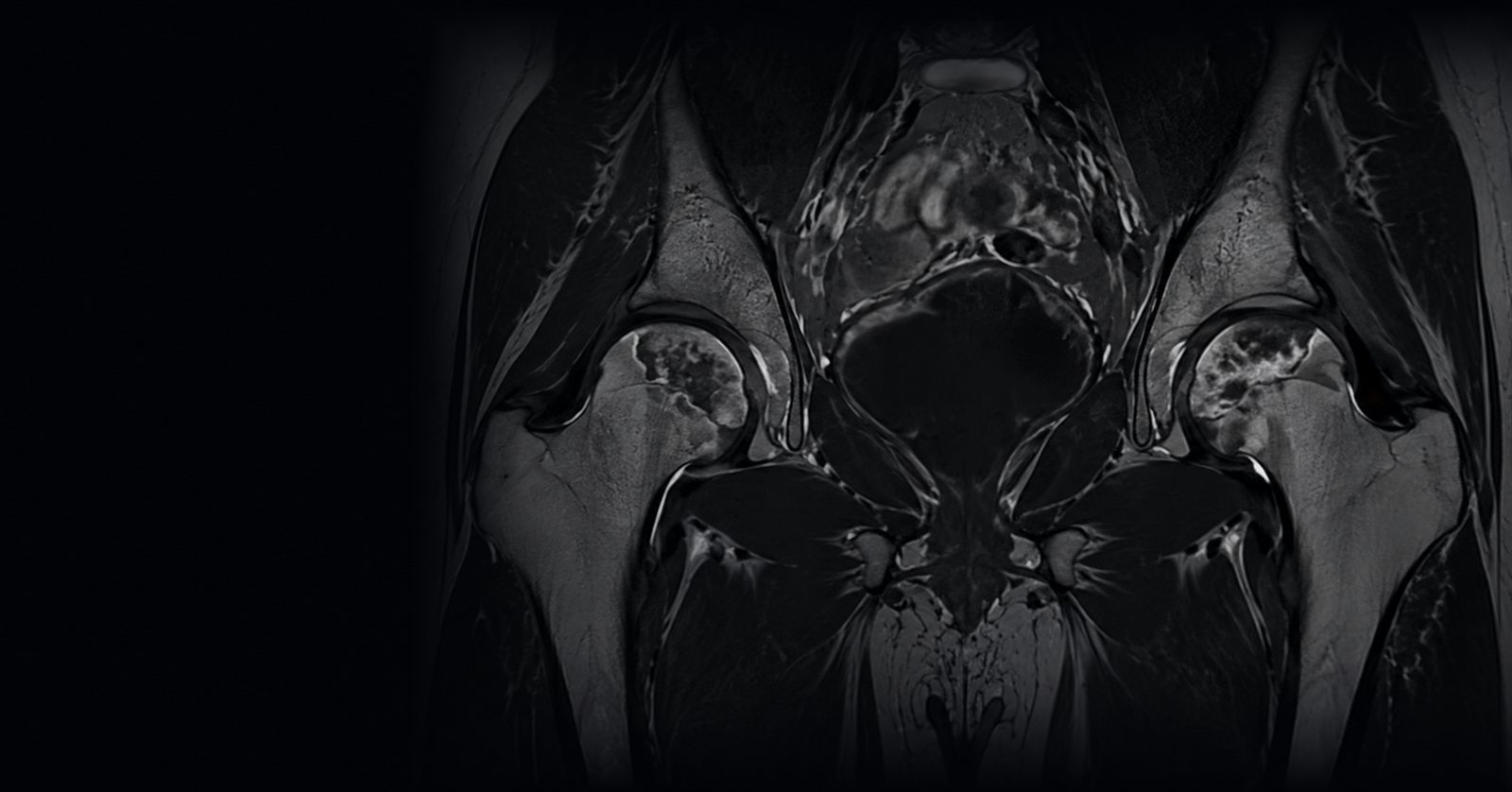
If you have developed pain in the groin or hip joint, and an MRI has revealed avascular necrosis, it's important not only to confirm the diagnosis but also to determine the stage of the disease and the condition of the femoral head. This largely determines the further treatment strategy.
What Is Avascular Necrosis
Avascular necrosis (also known as aseptic necrosis) of the femoral head is a condition in which the blood supply to an area of bone tissue in the femoral head is disrupted.
In the early stages, the shape of the femoral head may still be preserved. As the disease progresses, the bone loses strength, which can lead to a subchondral fracture and gradual flattening or collapse of the femoral head.
After this, the geometry of the hip joint changes and secondary osteoarthritis develops.
This is why avascular necrosis should be viewed not simply as a diagnosis, but as a process with different stages and different treatment options.
When You Should See a Doctor
- pain has appeared in the groin or hip joint without an obvious injury
- pain occurs during walking or exertion
- hip joint mobility has decreased
- you have developed a limp
- the pain is gradually increasing
- an MRI or X-ray has revealed signs of avascular necrosis
- avascular necrosis has already been diagnosed, but you need to determine further treatment strategy
- both hip joints are affected
Why It's Important to Determine the Stage of the Disease
With avascular necrosis, the same diagnosis label can describe fundamentally different clinical situations.
In the early stage, the femoral head may still retain its shape. In such situations, certain patients may be candidates for methods aimed at preserving their own hip joint.
If collapse of the femoral head has already occurred and pronounced secondary joint changes have formed, the possibilities for joint-preserving treatment become significantly limited, and hip replacement may need to be considered.
So the key question after diagnosis is not simply "is there necrosis?" but "what stage is it at, and can the joint still be preserved?"
Is Hip Replacement Always Necessary?
No.
The mere presence of avascular necrosis does not automatically mean the patient needs hip replacement.
Treatment strategy depends on:
- the stage of the disease
- the size and location of the affected area
- whether the shape of the femoral head is preserved
- the condition of the joint cartilage
- the patient's age
- level of physical activity
- severity of pain and functional limitations
This is why treatment decisions should be made after a comprehensive evaluation, not simply based on the words "avascular necrosis" appearing in an MRI report.
Joint-Preserving Treatment
If the disease is detected before significant collapse of the femoral head, methods aimed at preserving the patient's own joint may be considered in appropriate clinical situations.
The specific strategy depends on the stage and characteristics of the necrotic area.
One surgical approach used in the early stages is core decompression of the femoral head. Its goal is to create channels in the affected area and attempt to influence the course of the disease process before significant deformity of the femoral head develops.
In certain situations, other joint-preserving techniques may also be considered.
Their potential depends most heavily on how early the diagnosis was made and whether the structure of the femoral head is preserved.
When Hip Replacement Is Considered
If the disease has progressed, collapse of the femoral head has occurred, and significant structural changes have formed in the hip joint, joint-preserving methods may no longer provide the expected result.
In such cases, one treatment option is total hip replacement.
The goal of the operation is to reduce pain, restore mobility, and return the patient to a more active daily life.
Thus, with the same diagnosis, two patients may be recommended completely different strategies:
- early stage → attempt to preserve the patient's own joint
- late stage → hip replacement
01 — Consultation
We assess the nature and duration of the pain, hip joint mobility, gait, prior treatment, and possible factors related to the development of the disease.
02 — Imaging
We analyze X-rays and MRI scans of the hip joints.
MRI is especially important in the early stages, when structural changes may not yet be clearly visible on a standard X-ray.
03 — Staging
We assess the condition of the femoral head, the presence or absence of collapse, the extent of the affected area, and secondary joint changes.
04 — Choosing the Strategy
We determine whether there are grounds for joint-preserving treatment, or whether the changes are already so pronounced that hip replacement is the more appropriate option.
Our Approach
We don't just treat an "MRI report"
It's important to correlate imaging findings with the patient's complaints, joint function, and the stage of the disease process.
We First Assess Whether the Joint Can Be Preserved
Especially in young and active patients, it's important to determine whether real options remain for joint-preserving treatment.
Different Stages — Different Treatment
A method that may be appropriate at an early stage may no longer make sense after collapse of the femoral head. Conversely, hip replacement should not automatically become the first choice simply because a diagnosis has been made.
From Diagnosis to a Concrete Plan
The goal of the consultation is not simply to confirm the presence of avascular necrosis, but to answer the patient's main question: what to do next in their specific situation.
Is Avascular Necrosis the Same as Hip Osteoarthritis?
No. These are different pathological processes.
In avascular necrosis, the bone tissue of the femoral head is primarily affected. As the disease progresses and the head becomes deformed, secondary osteoarthritic changes in the hip joint may develop.
Can Avascular Necrosis Resolve on Its Own?
This disease requires monitoring and assessment of the risk of progression. The strategy depends on the stage, the size of the affected area, and clinical symptoms.
You should not rely on the hope that diagnosed avascular necrosis will resolve on its own.
If My X-ray Is Normal, Can I Still Have Necrosis?
Yes. In the early stages, changes may not be clearly visible on standard X-rays.
In the relevant clinical situation, MRI can be especially important for early diagnosis.
If Necrosis Was Found on MRI, Do I Already Need Surgery?
Not necessarily.
First, it's necessary to determine the stage, size, and location of the affected area, the condition of the femoral head, and the clinical symptoms. Only after that can the optimal strategy be discussed.
Can My Own Hip Joint Be Preserved?
In some patients at early stages, this possibility may be considered.
The chances and appropriateness of joint-preserving treatment depend primarily on the stage of the disease and whether the structure of the femoral head is preserved.
What Is Core Decompression?
This is a joint-preserving surgical procedure in which one or several channels are created in the head and neck of the femur.
The method may be considered for certain patients in the early stages of the disease. Its appropriateness is determined individually.
Why Is It Important Not to Delay a Consultation?
Because the possibilities for joint-preserving treatment depend on the stage of the disease.
After significant collapse of the femoral head develops, the choice of methods aimed at preserving the patient's own joint narrows considerably.
Are Both Hip Joints Often Affected?
Bilateral involvement is possible. That's why, once the diagnosis is established, it's important to assess the overall clinical picture and, if indicated, examine the other hip joint.
If the Femoral Head Is Already Destroyed, What Can Be Done?
In cases of significant collapse and secondary joint changes, the appropriateness of total hip replacement is assessed.
The decision depends on symptoms, the degree of structural changes, age, activity level, and other individual factors.
Diagnosed with Avascular Necrosis?
If your MRI or X-ray report already indicates avascular necrosis of the femoral head, it's important to determine the stage of the disease and the possibilities for preserving your own joint.
During the consultation, we will assess the results of your examinations, the condition of the hip joint, and determine the possible options for further treatment.
Avascular necrosis does not automatically mean you need hip replacement. Our task is to determine which treatment will be optimal for your specific stage of the disease.