Loss of a substantial segment of bone is one of the most challenging problems in reconstructive orthopedics. But even a large bone defect doesn't always mean the possibility of restoring the limb has run out.
What a critical bone defect is
After a high-energy injury, an open fracture, an infection, or repeated operations, a situation can arise where part of the bone is effectively lost.
Bone tissue can heal small defects on its own under the right conditions. With significant bone loss, however, the natural healing potential may not be enough, and a dedicated reconstructive strategy is needed to restore bone continuity.
The problem often isn't limited to the size of the defect alone. At the same time, it's necessary to assess limb stability, the condition of the soft tissues, blood supply, the presence of infection, previous operations, and the function of neighboring joints.
That's why treating these patients requires not a single operation, but a plan for reconstructing the limb as a whole.
When to seek treatment
- a significant segment of bone was lost after an injury
- a bone defect remained after an open or comminuted fracture
- part of a bone had to be removed because of infection
- a fracture has not healed for a long time due to a defect
- several operations have already been performed, but bone continuity has not been restored
- a cement spacer or other temporary construct has been placed
- there is significant limb shortening after bone tissue loss
- complex multi-stage treatment has been proposed and you need an assessment of possible reconstruction options
Can a large bone defect be restored?
In many cases, reconstruction is possible even with significant bone tissue loss.
But there is no single method that suits every defect.
The approach depends on:
- the location and size of the defect
- its underlying cause
- the condition of the remaining bone
- the condition of the soft tissues
- the presence or absence of infection
- limb length and axis
- the condition of the joints
- previous operations
- the overall functional potential of the limb
So the key question isn't only "how many centimeters of bone are missing?" but whether the conditions for a stable, functional limb reconstruction can be created.
What reconstructive treatment can achieve
Depending on the initial situation, treatment may be aimed at:
- restoring bone continuity
- replacing a significant bone defect
- creating stable support
- restoring limb length and axis
- achieving union
- controlling an infectious process
- improving the limb's ability to bear weight
- preserving the limb and restoring its function as fully as possible
With complex defects, it isn't always possible to fully restore the anatomy that existed before the injury. That's why it's important, even at the planning stage, to define a realistic functional goal for treatment.
Why treatment often happens in several stages
With critical defects, trying to solve every problem in a single operation isn't always the best approach.
If there is infection, nonviable tissue, instability, or a significant defect, it may first be necessary to create safe conditions for further reconstruction.
Treatment may include:
infection control and removal of nonviable tissue ↓ temporary stabilization and/or defect replacement ↓ preparation of the bone and soft tissues ↓ definitive reconstruction ↓ functional recovery
The number and sequence of stages are determined individually.
A temporary construct in this situation is not the final result — it's part of the overall treatment plan.
Reconstruction methods
Various reconstructive techniques exist for replacing large bone defects.
Depending on the clinical situation, the following may be considered:
- bone grafting
- induced membrane technique and staged reconstruction
- bone transport
- internal or external fixation methods
- structural reconstructive implants
- individualized 3D solutions for complex defects
- a combination of several methods
The choice of method depends on more than just the size of the defect. Its location, the condition of the soft tissues, infection status, mechanical conditions, and the ultimate treatment goal all matter.
We don't fit the patient to one technology — we fit the technology to the specific reconstructive task.
Individualized 3D solutions
In complex cases, standard implants may not be enough to restore the anatomy that was lost.
Modern CT imaging and digital planning make it possible to create a three-dimensional model of the defect and plan individualized reconstructive solutions.
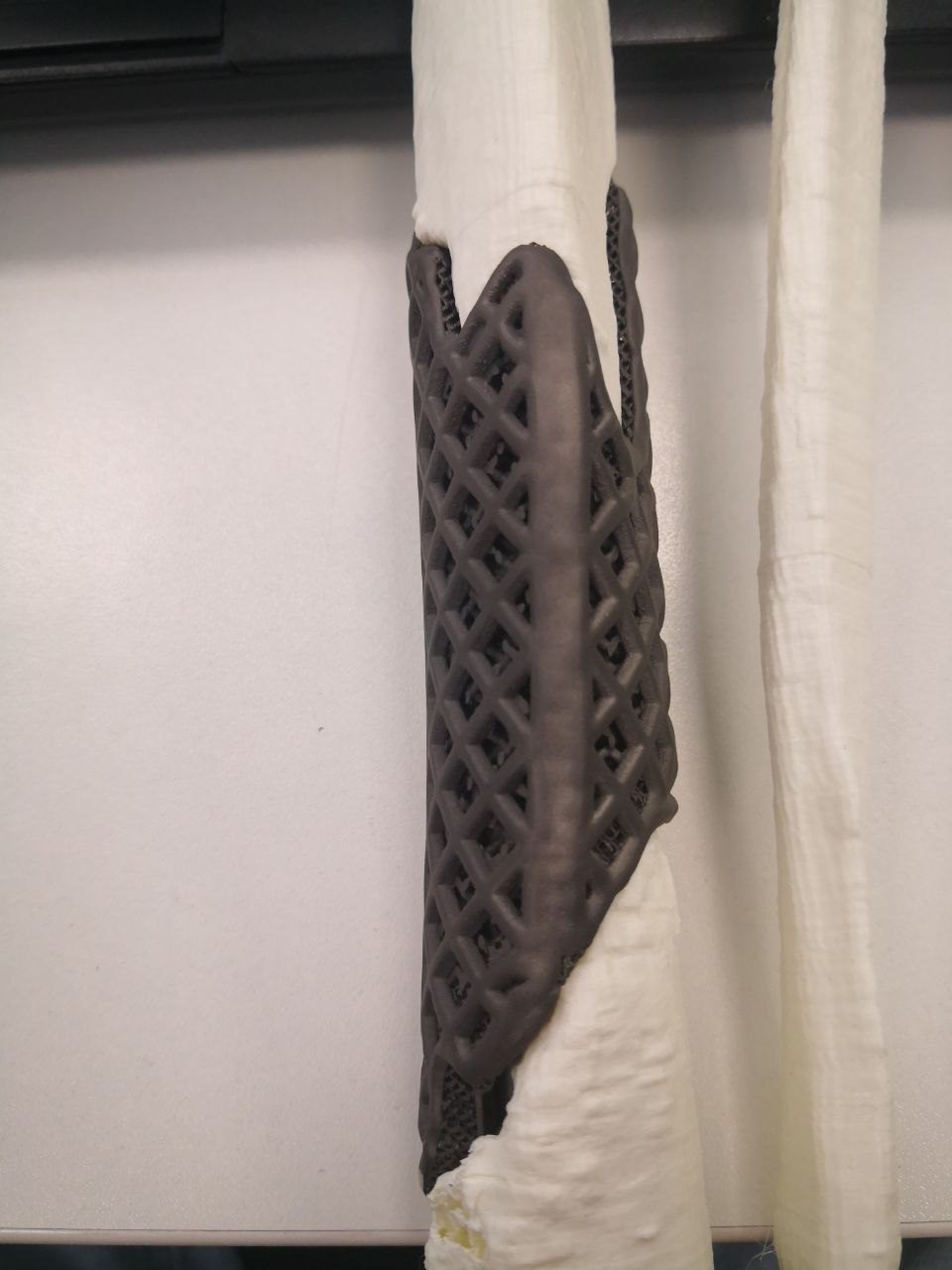
Where indicated, patient-specific 3D-printed implants, designed to match the specific anatomy and reconstructive task, can be used.
This approach is especially important in cases where a large defect, complex geometry, or previous operations make it impossible to achieve an optimal result with standard implants.
3D technology, however, is not an end in itself. It's one of the tools of reconstruction, used when it offers a specific clinical advantage.
01 — Reviewing the injury history
We review the original injury, previous operations, any existing implants, and the results of bacteriological and other tests.
For a complex reconstructive case, the history of prior treatment is critically important.
02 — Assessing the defect
We determine the location and size of the bone loss, the condition of the remaining bone tissue, soft tissues, and joints, and the limb's axis and length.
CT imaging and digital reconstruction are used when necessary.
03 — Building the strategy
We define the ultimate treatment goal and the sequence of stages.
If multi-stage treatment is needed, each stage is planned as part of a single reconstructive strategy.
04 — Reconstruction
The chosen method of defect replacement and stabilization is carried out according to the specific clinical situation.
05 — Functional recovery
After reconstruction, the loading regimen is gradually adjusted and functional recovery begins. Its duration depends on the scale of the defect and the reconstruction method chosen.
We plan the entire treatment journey, not just one operation
With a critical defect, it's important to understand from the very beginning what end result we're aiming for and what role each stage plays.
We combine biology and mechanics
Reconstruction takes more than simply filling in the missing part of the bone. It's necessary to provide both the conditions for healing and sufficient mechanical stability at the same time.
We use digital planning and individualized solutions
In complex cases, CT-based reconstruction, 3D modeling, and patient-specific implants make it possible to plan reconstruction to match the specific anatomy.
We assess the function of the whole limb
The ultimate goal isn't simply an unbroken line of bone on an X-ray, but a stable, weight-bearing, and as functional as possible limb.
From major bone loss to an active life
The patient presented 3 months after a severe lower-leg injury. By the time of presentation, the soft tissues had already healed, but a significant post-traumatic tibial defect had formed.
After a comprehensive assessment of the limb, individualized reconstruction planning was carried out. A patient-specific 3D implant, with geometry adapted to the specific defect, was manufactured to replace the bone defect.
The reconstruction was aimed not only at replacing the lost section of bone, but also at restoring the limb's continuity, stability, and weight-bearing capacity.
3 years after reconstruction
The patient maintains a high level of physical activity and goes on mountain hikes.
The ultimate goal of complex reconstruction isn't an X-ray. It's a functional limb that allows a person to return to an active life.
How large a bone defect can still be restored?
There's no single number of centimeters beyond which reconstruction automatically becomes impossible.
What matters is the location of the defect, the condition of the soft tissues, infection, the quality of the remaining bone, the condition of the joints, and the overall functional potential of the limb.
If part of a bone was removed because of infection, can it be restored?
In many cases, reconstruction is possible after an infected or nonviable section of bone has been removed.
However, before definitive reconstruction it's essential to achieve control of the infectious process and prepare the tissues for the next stage.
Will several operations always be necessary?
Not necessarily, but multi-stage treatment is common with large defects.
The number of operations depends on the cause of the defect, the presence of infection, the condition of the tissues, and the reconstruction method chosen.
What is a spacer, and why is it placed?
A spacer is a temporary construct that may be used during one stage of treatment.
Its function depends on the specific situation: it can help temporarily fill the defect, maintain space, and serve as part of the strategy for treating an infectious process.
Is a 3D-printed implant always needed?
No.
An individualized 3D implant is just one of the possible reconstruction tools. It's used when the anatomy of the defect and the clinical task make such a solution appropriate.
Can limb length be restored?
In some cases — yes.
The possibility and method of restoring length depend on the size of the defect, the condition of the tissues, any deformity, and the reconstructive strategy chosen.
I've already had many operations — is it worth coming in?
The number of previous operations alone does not determine the outlook for treatment.
The current condition of the bone, soft tissues, and joints, the presence of infection, and the functional potential of the limb need to be assessed.
How long does this kind of treatment take?
With critical defects, treatment can be lengthy and, in complex cases, involve several sequential stages.
Before starting reconstruction, it's important to discuss with the patient not just the planned operations, but also the approximate path from the first stage to functional recovery.
Can preserving the limb be guaranteed?
No.
The possibility of reconstruction depends on the severity of the injury, the condition of the vessels, nerves, bone, and soft tissues, infection, and other factors.
During the consultation, it's important to determine the realistic possibilities and risks of reconstructive treatment for the specific patient.
Losing part of a bone doesn't always mean losing the chance for reconstruction
If a significant bone defect has formed after an injury, an infection, or previous operations, the first task is to assess whether a stable, functional reconstruction can be achieved, and how to get there.
During the consultation, we'll review your previous treatment, the results of examinations, and the current condition of the limb, and put together a possible reconstructive strategy.
With complex defects, it's important to plan not just the next operation, but the final outcome and the entire path to it.