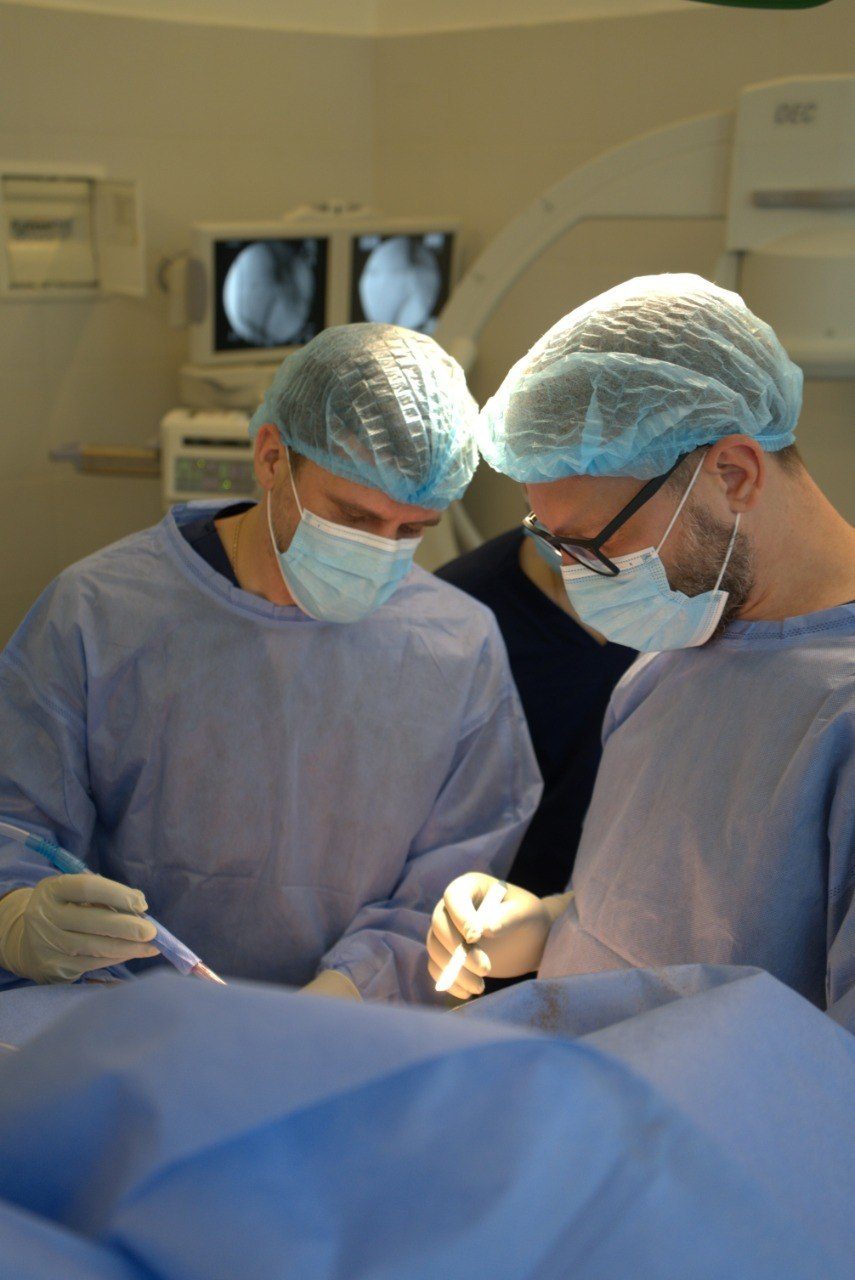
When hip pain limits walking, interferes with daily life, and conservative treatment no longer provides sufficient relief, joint replacement may be the next step in treatment.
When hip replacement becomes necessary
In advanced hip osteoarthritis, avascular necrosis, the aftermath of injuries, and other hip joint conditions, the joint's structures gradually lose the ability to provide pain-free, full-range movement.
Pain may initially appear only during exertion, then later during ordinary walking or even at rest. Mobility decreases, a limp develops, and it becomes harder to put on shoes, climb stairs, get into a car, or simply walk a familiar distance.
When conservative or joint-preserving treatment options no longer provide adequate results, total hip replacement becomes one way to restore function.
During the operation, the damaged joint surfaces are replaced with implant components. The goal is, first and foremost, to reduce pain, restore joint mobility and stability, and help the patient return to a more active life.
When it's time to see a specialist
- pain in the hip or groin area has become constant or is progressing
- walking familiar distances is getting harder
- pain occurs not only during activity, but also at rest or at night
- a limp has developed
- it has become difficult to put on shoes, socks, or perform other everyday movements
- hip mobility has noticeably decreased
- pain forces you to give up activities you used to enjoy
- conservative treatment no longer provides adequate relief
What can change after surgery
For the patient, the main goal of hip replacement is not the fact of having an artificial joint, but an improvement in everyday quality of life.
After surgery and an appropriate recovery period, hip replacement can help:
- significantly reduce pain
- increase comfortable walking distance
- improve hip mobility
- reduce limping
- make everyday activities easier
- improve the limb's ability to bear weight
- gradually return to work, travel, and familiar physical activity
The goal of treatment is to restore the greatest possible freedom of movement and reduce the limitations caused by a diseased hip joint.
Individualized surgical planning
Modern hip replacement doesn't begin with the choice of implant brand — it begins with detailed preoperative planning.
Before surgery, we assess hip joint anatomy, bone quality, the geometry of the femur and acetabulum, limb length, and the joint's biomechanical parameters.
Based on this data, we plan the size and position of the implant components, the method of fixation, and the surgical approach.
There is no single implant that is equally optimal for every patient. The choice of design, fixation method, and bearing surface depends on age, anatomy, bone quality, activity level, and the specific clinical situation.
What matters most in hip replacement
The outcome of the operation does not depend on the implant manufacturer or model alone.
What matters most:
- detailed preoperative planning
- correct positioning of the components
- implant stability
- restoring the anatomical center of the hip joint
- restoring limb length
- restoring offset and muscle balance
- an individualized choice of fixation method and bearing surface
- well-organized postoperative recovery
The goal is not simply to replace the damaged joint, but to restore its biomechanics and function as fully as possible.
Surgical approach
The surgical approach is not a goal in itself — it is one of the tools for performing the operation safely and precisely.
The choice depends on the patient's anatomy, the specifics of the hip joint, the nature of the pathology, and the planned operation.
In appropriate clinical cases, a Direct Anterior Approach (DAA) to the hip joint may be used, including a cosmetically oriented incision placed along a natural skin fold — the bikini incision.
This option allows the postoperative scar to follow the skin's natural lines. This can matter especially for patients for whom the cosmetic aspect of surgery is important.
That said, the choice of approach should not be determined solely by the size or location of the future scar. Safety of the operation, precision of component placement, and functional outcome remain the priority.
01 — Consultation and diagnosis
We start by understanding exactly what is troubling the patient and how much the problem limits their everyday life. We assess mobility, gait, limb length, and hip joint function, and review X-rays and any additional studies as indicated.
02 — Preoperative planning
We assess joint and bone anatomy, determine the surgical approach, and plan the position and parameters of the implant components and their method of fixation.
03 — Hip replacement
The damaged structures of the hip joint are replaced with implant components according to the preoperative plan, with attention to stability, anatomical relationships, and joint biomechanics.
04 — Early recovery
After surgery, mobilization begins, along with restoring walking and gradually expanding everyday activity. The pace and level of exertion are determined individually.
Not "one implant for everyone", but a solution for each patient
Anatomy, bone quality, age, activity level, and the cause of joint damage all differ from patient to patient. That's why implant design and surgical approach are chosen individually.
Planning before surgery
We assess hip joint anatomy, limb length, and biomechanical parameters in advance, and plan the future position of the implant components.
Attention to biomechanics
What matters isn't just placing the implant — it's also restoring joint stability, limb length, offset, and anatomical relationships.
From surgery to a return to activity
Hip replacement is only one stage of treatment. Early mobilization and consistent functional recovery are an important part of the final outcome.
Hip replacement after severe trauma
The patient is Major Oleksandr Noskovych of the Armed Forces of Ukraine, who sustained a severe hip injury. After initial medical care and five days of staged evacuation, he was admitted to the NMU University Clinic for specialized orthopedic treatment.
Examination revealed a complex injury — a femoral head fracture-dislocation against a background of acetabular dysplasia. Given the nature of the injury, the patient's anatomy, and his functional needs, the decision was made to perform total hip replacement.
The operation was performed using the Direct Anterior Approach (DAA) with a cosmetically oriented bikini incision. The primary goals were to restore hip joint stability, anatomical relationships, and limb function.
X-ray after surgery
Early mobilization began right after surgery: the patient stood up and started walking on the second day, and by the eighth day he was preparing for discharge from the clinic.
How do I know it's already time for surgery?
There is no single X-ray finding after which hip replacement automatically becomes necessary.
It's important to assess pain, mobility, walking ability, everyday limitations, and how effective previous treatment has been.
If your hip is making you walk less, give up activities you used to enjoy, rely constantly on painkillers, and treatment no longer provides sufficient relief, it's worth discussing next steps with an orthopedic surgeon.
Is it still possible to avoid surgery?
In many cases, yes. The options for conservative or joint-preserving treatment depend on the cause of the condition and the degree of structural change in the joint.
The purpose of a consultation is not to convince the patient that hip replacement is necessary, but to determine whether surgery is genuinely the best treatment option at this point.
Which implant is the best?
There is no universally "best" implant.
Modern systems differ in design, fixation method, and other characteristics. What matters isn't just the implant brand, but choosing the right design for the individual patient, thorough preoperative planning, and precise surgical execution.
Cemented or cementless implant?
Both fixation methods have their indications. The choice depends on age, anatomy, bone quality, and other characteristics specific to the patient.
Can the operation always be performed through an anterior or bikini approach?
No. The surgical approach is chosen individually.
The anterior approach and the bikini incision can be used in appropriate clinical situations, but the cosmetic result should never take priority over the safety and quality of the hip replacement.
Does it hurt a lot after surgery?
Postoperative pain is expected, especially in the first few days. It is managed with a comprehensive pain control protocol that allows early mobilization to begin.
The intensity of pain and how quickly it subsides vary from patient to patient.
When will I be able to stand and walk?
In most cases, mobilization begins in the early postoperative period. Walking aids may be used at first.
The exact weight-bearing regimen depends on the specifics of the operation and the patient's condition.
Will there be a difference in leg length after surgery?
Restoring limb length is one of the key goals of preoperative planning and hip replacement itself.
At the same time, in complex clinical cases, anatomical features and the need to ensure joint stability can affect the final outcome.
How long does recovery take?
Recovery happens gradually. In the first few weeks, the main goals are safe walking, gradually increasing activity, and restoring function.
Further improvements in strength, endurance, and confidence in movement can continue over the following months.
When can I drive a car?
The timeline depends on which side was operated on, recovery of limb control, the overall course of rehabilitation, and any medications being taken.
The return to driving is determined on an individual basis.
How long does a hip implant last?
Modern implants are designed for long-term function. Their lifespan depends on the design and placement of the implant, as well as the patient's age, body weight, physical activity, and other individual factors.
Can I return to sports and an active life?
The goal of hip replacement is precisely to help the patient return to a more active life.
Once the main recovery period is complete, many types of physical activity can become available again. Specific loads and sports should be discussed on an individual basis.
Need a consultation?
If hip pain is already limiting your walking and everyday activity, during a consultation we can assess the condition of your joint, review your test results, and discuss possible treatment options.
Not every patient with hip osteoarthritis or another hip condition needs a joint replacement. Our task is to determine which treatment approach will be optimal for your specific situation.