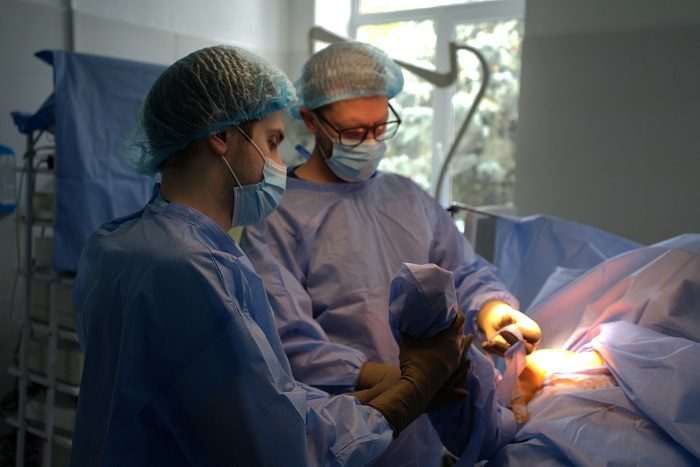
When shoulder pain has become constant, interferes with sleep, raising your arm, getting dressed, or performing everyday tasks, and conservative treatment no longer provides sufficient relief, shoulder replacement may be one of the treatment options.
When shoulder replacement becomes necessary
The shoulder joint provides a wide range of arm motion, so significant damage to it can substantially affect even simple everyday tasks.
In osteoarthritis, the aftermath of complex fractures, avascular necrosis, and some other conditions, pain, stiffness, and loss of function develop gradually.
A separate group of patients are those with significant damage to the rotator cuff tendons. In these cases, the problem may lie not only in the joint surfaces, but also in the loss of the shoulder's normal working mechanism.
When conservative or joint-preserving treatment options no longer provide adequate pain control and functional recovery, shoulder replacement may be considered.
When it's time to see a specialist
- constant or progressive shoulder pain
- night pain that interferes with sleep
- raising the arm has become difficult
- difficulty getting dressed, brushing your hair, or performing hygiene tasks
- shoulder range of motion has significantly decreased
- the arm has lost strength and function
- there is a history of a proximal humerus fracture
- advanced shoulder osteoarthritis has been diagnosed
- previous treatment no longer provides adequate results
What can change after surgery
The main goal of shoulder replacement is not simply to replace damaged structures, but to reduce pain and restore as much arm function as possible.
After surgery and an appropriate recovery period, shoulder replacement can help:
- significantly reduce shoulder pain
- reduce or eliminate night pain
- improve arm mobility
- make self-care and everyday tasks easier
- improve the ability to raise and use the arm
- gradually return to familiar everyday activity
The goal of treatment is to make the arm functional again in everyday life and reduce as much as possible the limitations caused by pain and loss of mobility.
Which type of replacement is needed
Unlike many other joints, the condition of the rotator cuff — the tendons that provide shoulder stability and movement — is especially important in shoulder replacement.
This is why fundamentally different implant designs may be needed for different patients.
Anatomic shoulder replacement
An anatomic implant reproduces the shoulder's natural structure: the head of the humerus is replaced with an artificial head, and the glenoid is replaced with a matching component.
This option may be used when the joint's anatomy allows it to be restored and the rotator cuff retains the necessary function.
Reverse shoulder replacement
In reverse shoulder replacement, the joint's geometry is changed: the design creates a different biomechanics that allows the deltoid muscle to play a greater role in raising the arm.
This option may be used for significant rotator cuff insufficiency, certain complex fractures and their aftermath, and other clinical situations where anatomic replacement is not the optimal solution.
The choice between anatomic and reverse replacement is determined not by the patient's age alone, but by the condition of the joint, bone quality, the rotator cuff, and functional needs.
Individualized surgical planning
Shoulder replacement begins with a detailed assessment not only of the bones, but of the entire functional shoulder system.
Before surgery, we assess:
- shoulder joint anatomy
- the degree of joint surface damage
- the condition of the humeral head and glenoid
- bone quality
- rotator cuff function
- range of motion
- previous injuries and operations
In addition to X-rays, CT imaging may be used for planning in complex cases, and other imaging methods for assessing soft tissue as indicated.
Based on this data, we determine the type of implant, its parameters, and the surgical approach.
What matters most in shoulder replacement
The outcome of the operation does not depend on the implant model or manufacturer alone.
What matters most:
- correctly determining the indications for surgery
- choosing between an anatomic and a reverse design
- assessing the condition of the rotator cuff
- detailed preoperative planning
- correct positioning of the components
- implant stability
- bone condition and quality
- consistent postoperative recovery
The goal is not simply to place an implant, but to choose the design and surgical strategy that match the specific condition and allow the greatest possible recovery of arm function.
01 — Consultation and diagnosis
We start with what is troubling the patient: pain, night pain, restricted movement, weakness, or an inability to raise the arm.
We assess shoulder mobility and function, and review X-rays and the results of other studies.
02 — Preoperative planning
We assess joint anatomy, bone quality, and the condition of the rotator cuff. We determine which type of shoulder replacement best fits the specific clinical situation.
03 — Shoulder replacement
The damaged structures of the shoulder joint are replaced with components of an anatomic or reverse implant according to the preoperative plan.
04 — Recovery
After surgery, a staged recovery process begins. Its pace depends on the type of replacement, the condition of the soft tissues, the nature of the underlying condition, and the specifics of the operation.
First — the cause of lost function
Osteoarthritis, rotator cuff damage, and a complex fracture and its aftermath can each require a different surgical approach. That's why it's important, first of all, to understand why the shoulder hurts and has lost function.
Not one implant type for everyone
Anatomic and reverse designs work on different biomechanical principles. The choice is determined by the specific condition and the state of the shoulder joint.
Detailed preoperative planning
Assessing bone anatomy, the glenoid, and soft tissues allows us to plan the implant type and component position before surgery.
From surgery to arm function
Shoulder replacement is only one stage of treatment. Further recovery of movement and function requires proper, consistent rehabilitation.
Reverse shoulder replacement after severe trauma
X-ray before surgery | X-ray after surgery
The patient is a Ukrainian service member with severe post-traumatic changes in the shoulder joint and significant loss of arm function.
Given the nature of the injury and the condition of the shoulder joint, reverse shoulder replacement was chosen. This design changes the joint's biomechanics and allows the deltoid muscle to play a greater role in raising the arm.
At the O.O. Bohomolets National Medical University Clinic, reverse shoulder replacement was performed with the goal of reducing pain and restoring as much arm function as possible.
How do I know shoulder replacement is already needed?
The decision is not made from an X-ray alone.
It's important to assess pain intensity, night pain, mobility, strength, and how much the shoulder is interfering with using your arm in everyday life.
If pain and loss of function remain significant despite treatment, it's worth discussing next surgical steps with an orthopedic surgeon.
Is it still possible to avoid surgery?
In many cases, yes. The options for conservative or joint-preserving treatment depend on the cause of the condition and the degree of structural change.
The purpose of a consultation is to determine whether other treatment options have genuinely been exhausted and whether shoulder replacement is the optimal solution.
What is a reverse shoulder implant?
This is a design in which the shoulder's usual geometry is altered. As a result, its biomechanics change, and the deltoid muscle can more effectively help raise the arm.
This is especially important in cases where the rotator cuff is significantly damaged and cannot perform its function normally.
Which is better — anatomic or reverse implant?
This isn't a matter of "better or worse." These are two different designs for different clinical situations.
The choice depends on the condition of the joint, the rotator cuff, bone quality, the nature of the pathology, and other individual factors.
Will I be able to raise my arm after surgery?
Restoring the ability to raise and use the arm is one of the main functional goals of the operation.
The final range of motion depends on the initial condition of the joint, muscles, and tendons, the type of replacement, and the course of rehabilitation.
Does it hurt a lot after surgery?
Postoperative pain is expected, especially in the first few days. It is managed with a comprehensive pain control protocol.
Afterward, pain gradually decreases, but the pace of recovery varies from patient to patient.
How long will my arm be in a sling?
The need for and duration of a brace or sling depend on the type of operation, the condition of the soft tissues, and the specifics of the individual case.
The regimen is determined by the surgeon after the operation.
When does shoulder rehabilitation start?
The recovery program is determined by the type of replacement and the condition of the tissues.
The permitted movements and the timeline for expanding them can vary significantly between patients, so rehabilitation should never be rushed without the surgeon's guidance.
How long does recovery take?
Recovery of shoulder function happens gradually over several months. The pace depends on the underlying condition, the type of operation, the state of the muscles and tendons, and how the individual responds to rehabilitation.
Can I do sports after shoulder replacement?
Once the main recovery period is complete, some physical activities may become available.
The acceptable level of activity depends on the type of implant, shoulder function, and the nature of the specific sport, and is determined on an individual basis.
How long does a shoulder implant last?
Modern shoulder implants are designed for long-term function. Their lifespan depends on the design, bone quality, precision of placement, activity level, and other individual factors.
Need a consultation?
If shoulder pain is interfering with sleep, raising your arm, or performing everyday tasks, during a consultation we can identify the cause of lost function, review your test results, and discuss possible treatment options.
Not every patient with shoulder pain or osteoarthritis needs a joint replacement. Our task is to determine whether surgery is needed and which treatment approach will be optimal for your specific situation.