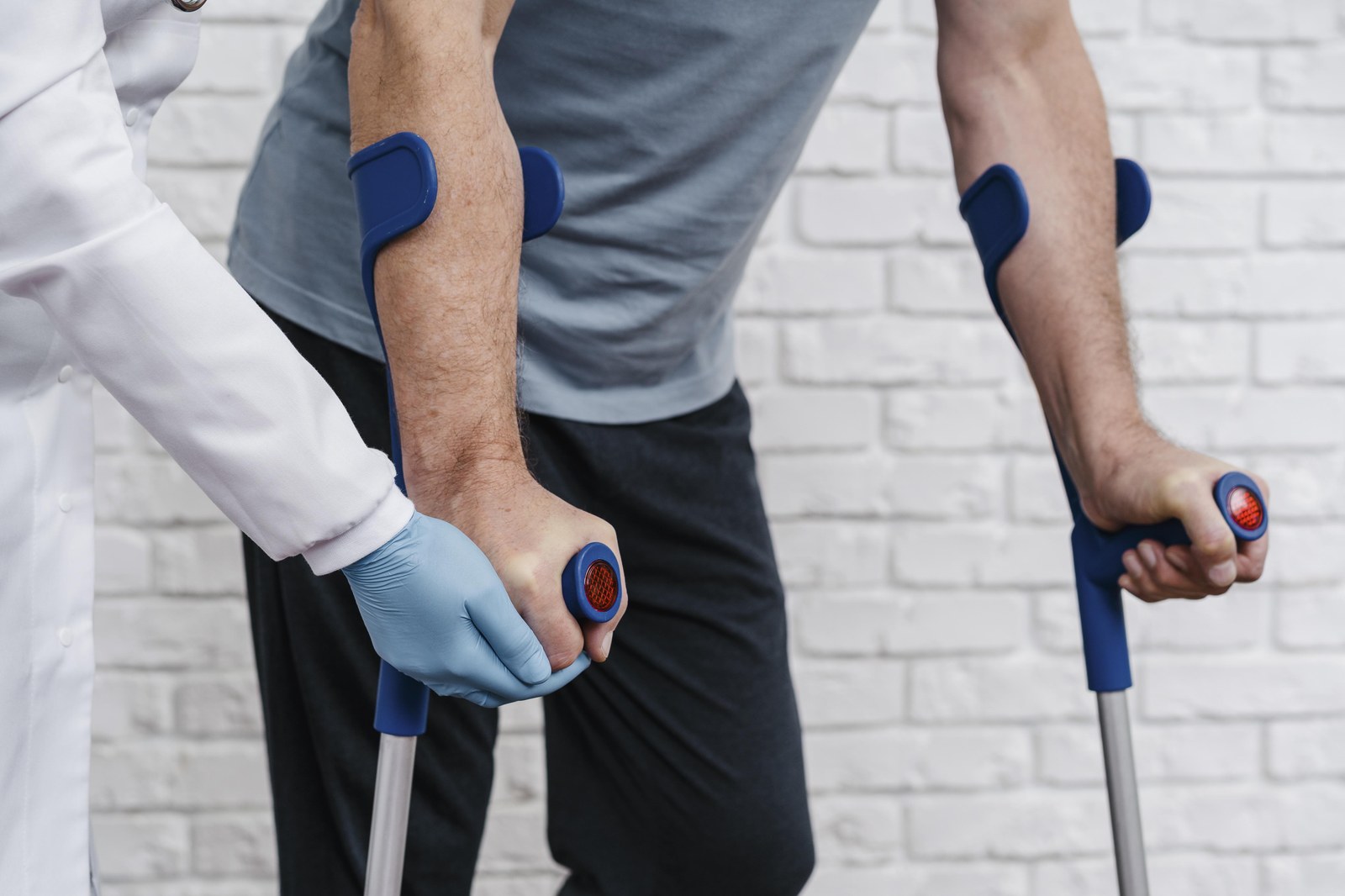
An injury and the initial surgery do not always mark the end of treatment. If pain, deformity, limping, limb shortening, or difficulty walking and bearing weight persist after a fracture, reconstructive treatment is possible in many cases.
The injury is behind you, but function hasn't returned
After complex fractures, the main goal of the first stage of treatment is often to stabilize the injured limb and create the conditions for healing.
However, the further course of recovery can vary.
A fracture may fail to unite, or it may heal in an incorrect position. Deformity, shortening, a shift in limb axis, restricted movement, or pain may remain. After multi-stage treatment, bone defects or problems related to previously placed hardware can also occur.
In such situations, the question is no longer simply "has the fracture healed?" but how fully the anatomy and function of the limb have been restored.
When to seek treatment
- the fracture has not healed for an extended period
- the bone has healed with a deformity
- the limb has become shorter after the injury
- the axis of the leg or arm has changed
- limping persists
- there is pain when walking or bearing weight
- movement in the adjacent joints remains restricted
- hardware that was placed is causing problems or has lost stability
- limb function remains unsatisfactory after several previous operations
- a post-traumatic bone defect has formed
- you need a repeat assessment of reconstructive treatment options
What reconstructive treatment can change
The goal of reconstruction is not simply to perform another operation.
First, it's necessary to determine exactly which consequences of the injury are currently limiting the limb's function, and only then build a plan to correct them.
Depending on the specific situation, reconstructive treatment may be aimed at:
- achieving union of a nonunion fracture
- correcting a malunion
- restoring limb axis
- eliminating or reducing pathological rotation
- correcting shortening
- restoring stability
- reconstructing a bone defect
- improving the limb's ability to bear weight
- improving gait and everyday function
The main goal is not simply to improve the appearance of an X-ray, but to restore the limb's function as fully as possible.
Malunited fractures
If bone fragments have healed in an incorrect position, a post-traumatic deformity can develop.
Externally, this is sometimes visible as curvature or shortening of the limb. In other cases the deformity is less obvious, but it still changes biomechanics, load distribution, and the function of neighboring joints.
In such situations, surgical correction of the bone's position followed by stabilization in the planned position may be considered.
It's important to evaluate not only the site of the original fracture, but the whole limb as a single biomechanical system.
Fracture nonunion
If a fracture is not showing proper healing within the expected time frame, the cause needs to be identified.
Both mechanical and biological conditions are important for successful union. So the problem may be related to the stability of fixation, the nature of a bone defect, tissue condition, blood supply, or other factors.
A repeat operation in this situation should not simply replace one piece of hardware with another — it should address the causes preventing union.
Limb shortening and deformity
After complex fractures, a difference in limb length, an angular deformity, or a rotational deformity can remain.
This can show up as limping, fatigue, an altered gait, pain, and overload of neighboring joints.
Before reconstruction, it's important to accurately determine:
- the degree of shortening
- the location and severity of the deformity
- the condition of the joints
- the quality of the bone tissue
- the condition of the soft tissues
- previous operations and any hardware that was placed
After this, it's possible to determine whether deformity correction, length restoration, or a combination of both is needed.
Complex bone defects
With high-energy injuries, after multi-stage treatment, or after repeated operations, a significant bone defect can develop.
Such cases require separate reconstructive planning.
Depending on the nature of the defect, multi-stage reconstruction methods, bone grafting, defect-replacement techniques, and individualized reconstructive solutions may be used.
Critical bone defects are a dedicated focus of our work, so a specialized page describing treatment options for them in more detail is available.
Why a repeat operation needs new planning
After one or more previous operations, the anatomy may already differ significantly from what it was immediately after the injury.
There may be:
- previously placed hardware
- bone defects
- scarring
- axis or length abnormalities
- contractures
- changes in soft-tissue condition
- the consequences of previous surgical interventions
So a reconstructive operation shouldn't be seen simply as "redoing the previous one."
It's a new clinical situation that requires a new treatment plan.
01 — Reviewing previous treatment
We review the history of the injury, previous operations, X-rays, and other examinations.
It's important to understand not only the limb's current state, but also how it developed.
02 — Assessing the current problem
We determine exactly what is limiting function: nonunion, deformity, shortening, instability, a bone defect, joint condition, or a combination of several problems.
03 — Reconstruction plan
We build the treatment sequence: what needs to be corrected, whether it can be done in one operation or requires multi-stage treatment, and which method of stabilization is optimal.
04 — Reconstructive surgery
The planned correction is carried out, restoring anatomy, stability, length, or bone continuity according to the specific clinical situation.
05 — Functional recovery
After surgery, a loading regimen and a functional recovery program are defined. Their duration depends on the complexity of the reconstruction and the condition of the limb.
We start with identifying the problem, not with surgery
After a complex injury, several causes of impaired function can exist at the same time. It's important to determine which ones need correction, and in what order.
We assess the whole limb
Reconstructing one segment can affect axis, length, gait, and the function of neighboring joints. So planning should not be limited to the area of the old fracture alone.
We plan the end result
In multi-stage treatment, every operation should be part of the overall reconstructive plan, not a stand-alone decision.
We use individualized reconstructive solutions
Complex post-traumatic cases don't always fit a standard scheme. The approach is defined according to the patient's specific anatomy, defect, and functional needs.
Initial situation
A patient with a severe injury to the right lower leg and a significant bone and soft-tissue defect. After the initial surgical treatment, a large segmental tibial defect had formed.
In a situation like this, the task is no longer simply stabilizing the fracture. It's necessary to restore the missing bone segment, preserve limb length and axis, and create the conditions for restoring the limb's weight-bearing function.
X-ray — initial condition / large tibial defect
The chosen reconstruction strategy
Distraction osteogenesis and bone transport based on Ilizarov principles were chosen to restore the defect.
The method works by gradually moving a viable segment of the patient's own bone toward the defect. At the same time, new bone tissue — the regenerate — forms in the distraction zone.
In this way, the patient's own body is effectively used to gradually restore the missing segment with the patient's own bone tissue.
X-ray — bone transport stage in an external fixation frame
Why this is a lengthy treatment
Reconstructing large defects with distraction osteogenesis is not a single operation but a lengthy, staged process.
The bone segment must be moved gradually, with ongoing monitoring of regenerate formation, segment position, and limb axis, and after transport is complete, sufficient remodeling and consolidation of the newly formed bone must be awaited.
This is why treating large post-traumatic defects requires not just a correctly performed operation, but a consistent reconstructive strategy and long-term follow-up.
Result
After completing reconstructive treatment and removing the frame, continuity of the tibia was restored and the limb was preserved.
The final X-rays show pronounced post-traumatic bone remodeling in the reconstruction zone. In such complex cases, the goal of treatment is not to create a "perfect" radiographic picture, but to restore a weight-bearing segment and the greatest possible function of the limb.
Final X-ray after frame removal
What this case demonstrates
Large post-traumatic bone defects have no single universal treatment method.
In some situations the optimal solution may be distraction osteogenesis and bone transport; in others, bone grafting, internal fixation, individualized 3D implants, or a combination of several reconstructive methods.
The goal of reconstruction is not simply to close the defect on an X-ray, but to restore a weight-bearing, functional limb.
If a fracture has already healed incorrectly, can anything be fixed?
In many cases — yes.
The possibility of correction depends on the nature and location of the deformity, the condition of the bone tissue, joints, and soft tissues, and the overall function of the limb.
To do this, the parameters of the deformity first need to be accurately determined and the correction planned.
How long should I wait if a fracture isn't healing?
There is no universal time frame for all fractures. Healing speed depends on the location, the nature of the injury, tissue condition, the method of fixation, and many other factors.
If follow-up examinations don't show the expected progress, or if pain and instability persist, the situation should be reassessed.
Does old hardware always need to be removed?
No.
The decision depends on its position, stability, the type of planned reconstruction, and other factors. In some situations the hardware needs to be replaced or removed; in others it can remain part of the treatment.
Can leg shortening after a fracture be corrected?
In certain clinical situations — yes.
The method depends on the degree of shortening, the presence of an accompanying deformity, the condition of the bone, and the patient's functional needs.
Can a deformity be corrected and the limb lengthened at the same time?
In some cases this is possible.
But whether single-stage or staged correction is appropriate is decided individually, after assessing the anatomy and the complexity of the reconstruction.
I've already had several operations — is it worth coming in again?
The number of previous operations alone does not determine whether further treatment is possible.
What matters more is the current condition of the bone, soft tissues, and joints, the presence of infection, the nature of the deformity, and the functional potential of the limb.
Can full functional recovery be guaranteed?
No. With complex post-traumatic conditions, the outcome depends on the severity of the original injury, the condition of the tissues, joints, nerves, and vessels, the number of previous operations, and other factors.
The goal of a consultation is to determine a realistic outcome to aim for in a specific situation.
Is reconstruction always done in a single operation?
No.
Some deformities can be corrected in a single stage. Complex defects, infectious complications, and combined problems may require several sequential stages.
What examinations should I bring to the consultation?
It's best to bring previous X-rays, CT scans or other imaging, discharge summaries from operations, and information about any hardware that was placed.
This helps reconstruct the treatment history and better understand the current problem.
If some documents are missing, the necessary scope of additional examinations can be determined after an in-person assessment.
The injury is behind you, but the problem remains?
If pain, deformity, shortening, limping, or restricted function persist after a fracture or previous operations, this doesn't always mean that treatment options have run out.
During the consultation, we'll review your previous treatment, assess the current condition of the limb, and identify possible reconstruction options.
With complex post-traumatic conditions, the first task is to understand what can realistically be restored and how to achieve it.